Estimated reading time: 9 minutes
Last Updated:
Key Takeaways
- Good records help you claim eligible deductions and provide evidence if the ATO reviews your return.
- Keep tax receipts and records of all income as well as the expenses you intend to claim.
- Digital copies of tax receipts are generally easier to organise, preserve and access at tax time.
- Most tax records must be kept for five years from the date you lodge your return, but some asset and investment records need to be kept longer.
- Not every work-related purchase is deductible, so keep the receipt and ask your accountant when you’re unsure.
Want to avoid missing eligible deductions and make tax time less stressful?
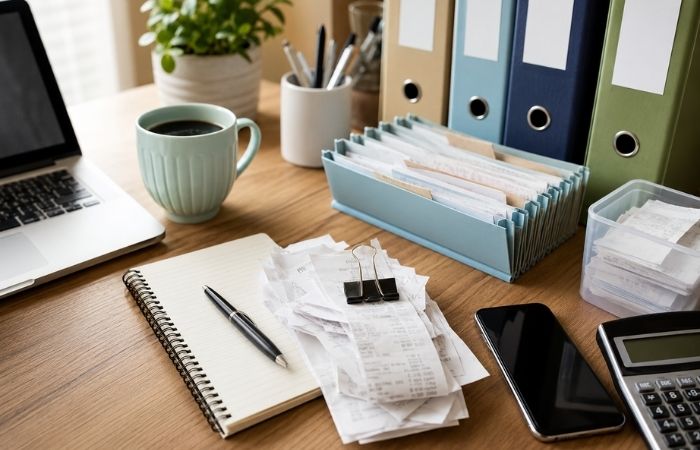
It starts with how you manage your receipts and tax records throughout the year. Take a photo of the receipt as soon as you buy something work-related and keep a folder on your phone with everything saved in one place!
Why is record keeping important?
The ATO is cracking down on work-related deductions, so keeping clear, up-to-date records isn’t just helpful; it’s essential.
Whether you’re a freelancer, have a side-hustle, you’re a sole trader or full-time employee, these simple record keeping habits will help you:
- Maximise your refund: Claim every deduction you’re entitled to, without missing a cent. All your records should be right there when you need them.
- Be prepared: If the ATO questions a claim, you have the evidence. The ATO may review a claim while processing your return or well after it has been lodged.
- Simplify your finances: Organised records make it easier to apply for loans, get financial advice and manage insurance.
The bottom line: Good record keeping doesn’t just boost your refund; it brings clarity to your entire financial situation.
Here’s what you need to know about keeping records for tax:
When you keep tax-related records organised during the year, completing your tax return is so much easier. Plus, if any claim is questioned, you can quickly prove it’s legitimate.
Aside from that, the most important benefit is up to date financial records and tax receipts mean that you always claim all the tax deductions you’re entitled to at tax time.

Record keeping isn’t just good for your tax refund
A clear outline of your income and expenses is the first thing you need to supply if you:
- Need financial advice
- Want to purchase or refinance a property
- Get a business loan
- Increase insurance cover
Good record keeping makes tax time easier and helps you manage other financial decisions.
What tax records and receipts should you keep?
The records you need depend on your income, expenses, assets and personal circumstances. Only some of the following categories may apply to you. However, it is still useful to understand the main types of deductions, so you know which records to save.
Income records
Keep records of all the income you receive during the financial year, including:
- Salary and wages
- Investments
- Bank interest
- Government payments
- Dividends
- Managed funds
- Allowances
- Rental income
- Income from renting out a room or part of your home
Note: Banks, investment providers, managed funds and property managers may provide annual statements. Check that the information is complete and keep any additional records needed to support the amounts in your return.
Tax deduction records
Next, you’ll need a record of all your tax-deductible expenses. This is how you bump up your tax refund:
1. General expenses
- Tax agent fees, including tax return preparation
- Income protection costs
- Charity donations
- Private health cover (your private health fund should provide an annual statement in your online account)
2. General work-related expenses
- Professional membership fees
- Licence, registration and certificate fees
- Union fees
3. Education expenses
- Course fees, including textbooks
- Related travel costs
- Accommodation and meals when required to stay away from home
- Professional journals, subscriptions and work-related publications
4. Work-related equipment
- Calculators and electronic organisers
- Computer-related consumables
- Computers and laptops
- Tablets or similar small electronic equipment
- Mobile phones (and accessories)
- Software
- Briefcases and carry bags
- Protective equipment, such as sunscreen, hard hats, harnesses and safety glasses, where required
- Sunglasses (if you work outside)
- Technical instruments
- Tools of your trade
5. Work-related travel
- Tolls
- Personal car or vehicle costs (see our blog on how to claim tax deductions for car use)
- Parking fees
- Public transport fares
- General travel expenses, including flights, taxis, etc.
- Accommodation and meals (if working away from home overnight)
6. Working-from-home expenses
- A record of the hours you worked from home
- Desks, chairs and other office furniture
- Office equipment
- Home office running costs (electricity, internet usage)
- Stationery
- Postage
7. Clothing purchase and maintenance
- Protective clothing
- Uniforms (with logo)
- Laundry and dry-cleaning costs for eligible work clothing
8. Rental property and investment records
- Rental income statements
- Loan interest records
- Property management fees
- Council rates and insurance
- Repair and maintenance invoices
- Capital works and depreciation documents
- Purchase and sale documents
- See our blog on 27 Valuable Rental Property Tax Deductions
9. Newly acquired asset costs
- Rental property
- Commercial property
- Contracts and invoices
- Settlement statements
- Legal fees
- Purchase and loan documents
- Improvement costs
- Work vehicle
9. Records of recently disposed or sold assets
- Sale contracts
- Settlement statements
- Selling costs
- Legal and agent fees
- Records of the original purchase and improvements
11. Expense records relating to disability, attendant care or aged-care claims

Please note: If a work-related asset costs more than $300, you will generally need to claim its decline in value over time (depreciation) rather than deducting the full purchase price immediately. Different rules may apply depending on the asset, how it is used and whether you operate a business.
How long should you keep tax receipts?
In most cases, you must keep your tax records for five years from the date you lodge your tax return. Some records need to be kept for longer, particularly those relating to depreciating assets, capital gains tax assets and ATO disputes. The ATO suggests that you keep your records for five years if you:
- Claimed a deduction for decline in value (depreciation)
- You need to keep these records for five years after the date of your final depreciation claim.
- Acquire or dispose of an asset
- You should keep this documentation for at least five years after you sell the asset, so you can work out any capital gain or loss.
- Are in dispute with the ATO
- You should keep these records for five years from the date the dispute is finalised.

Good habits for tax record keeping
Get organised
Organise your records by financial year and expense category. This way, at tax time you won’t find yourself frantically rummaging through mountains of receipts and paperwork.
Track your expenses as you go
Maintain a detailed list of your expenses, along with a running total for each category. To make tax time easier, update this regularly so you always have accurate totals on hand. Download our free expense trackers.
Back up your receipts
Scan or photograph each receipt or supporting document as soon as you receive it to create an electronic backup. Check that the supplier, purchase details, date and amount are easy to read.
This simple habit offers three key benefits:
- Preserves receipts that may fade over time.
- Protects against loss or damage to the original.
- Makes attaching documents to your tax return quick and hassle-free, saving you time.
Etax tip: Log in to your Etax account at any time and save your receipts in a few clicks!
Always keep proof of tax-deductible expenses
Make sure you always get a receipt for any expense you may be able to claim as a tax deduction. Remember, you can’t claim a tax deduction unless you have proof of purchase. If you don’t get a receipt for a payment at the time, follow up with the supplier.
Any Other Questions?
Frequently asked questions
Keep records of the income you receive and the expenses you claim. These may include receipts, invoices, bank statements, income statements, logbooks, diary records, contracts and documents relating to investments or assets.
In most cases, you should keep records for five years from the date you lodge your tax return. Different periods may apply to depreciating assets, capital gains tax assets, property investments and ATO disputes.
Generally, yes. Digital copies should include all the original information and remain easy to access and read.
Possibly, but it depends on the expense and the evidence available. Bank statements alone may not be enough. Keep any alternative evidence and ask your accountant before claiming it.
If your total work-related expenses are $300 or less, you don’t need receipts, but you must be able to show how you worked out your claim and spent the money. Once your total exceeds $300, you need written evidence for the whole amount, not just the part above $300. Separately, from the 2026–27 income year, a new $1,000 standard deduction lets eligible taxpayers claim up to $1,000 in work-related expenses without any evidence.
A bank or credit card statement may show that you made a payment, but not what you purchased or how the expense was work-related. In most cases, it is not sufficient evidence on its own.
A valid record should generally identify the supplier, the amount paid, what you purchased, the date of purchase and the date the document was created. Extra records may be needed to show the work-related use of an item.
You can upload supporting documents to your Etax account, so they are available when your accountant reviews your tax return.