Estimated reading time: 8 minutes
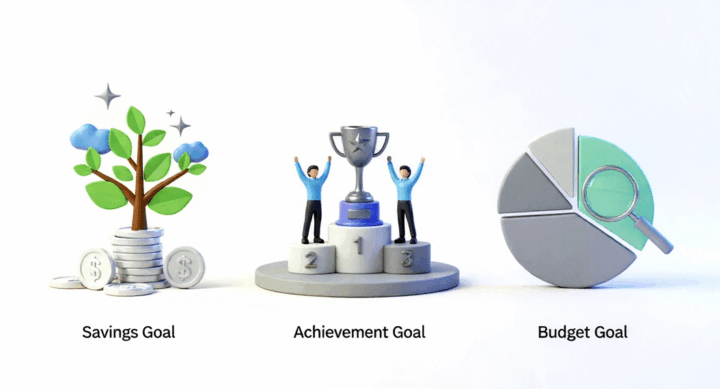
If your mind is full of goals but they all seem so overwhelming that you keep putting them off, this article is for you. We look at how you can achieve more by aiming for less. That’s right, forget huge lists and financial plans. This year, discover the power of 3 achievable financial goals only: one savings goal, one achievement goal, and one budget goal. Before diving into the details, here are the key takeaways to keep in mind.
Key Takeaways
- Aim for just 3 achievable financial goals a year: one savings goal, one achievement goal, and one budget goal.
- Fewer goals lead to more focus, increasing your likelihood of success.
- Set a specific savings goal, automate transfers, and break it down into monthly chunks for better results.
- Your achievement goal should enhance your skills or career; share it with others for accountability.
- For your budget goal, target one spending category or habit, and make small changes for lasting impact.
- These strategies help you stay focused, automate tasks, and reflect your life’s current priorities.
Fewer goals mean more focus. More focus means you’re far more likely to follow through. It’s really that simple.
The 3-Goal Framework for Financial Goals
1. Set One Savings Goal
Your savings goal should be specific, measurable, and exciting enough that you’ll stick with it. Pick one target that matters most right now.
How to make a savings goal happen:
- Automate transfers to a high-interest savings account the day after payday.
- Save windfalls like tax refunds, bonuses or gift money, before you’re tempted to spend them.
- Break your yearly target into monthly chunks. If you’re aiming to save $6,000, that’s just $500 a month.
- Consider a round-up savings account that saves your spare change automatically.
2. Set One Achievement Goal
This is your growth goal, something that elevates your work or career. It could be professional development, a personal milestone, or learning a skill that improves your productivity or boosts your income.
How to make an achievement goal happen:
- Tell people about your goal, it makes you accountable. Or join a group working toward similar goals. For example: business networking.
- Break your goal into smaller, easily achievable milestones and give yourself mini celebrations along the way.
- If it’s not directly related to your current job, schedule regular times through the week or fortnight to allocate time to work on your goal.
- Stay motivated by using creative visualisation techniques. It works by aligning your thoughts, emotions, and actions with the goal outcome.
3. Set One Budget Goal
Rather than overhauling your entire financial situation, pick one category to work on or one habit to build. Small, consistent changes create lasting results.
How to make a budget goal happen:
- Track your spending to see where you need to rein in your spending most, then focus just on that area.
- Consider the 50/30/20 rule. Spend 50% of your income on things you need, 30% on things you want and save the remaining 20%.
- Try a monthly “no-spend” challenge. E.g. No takeaway food one month, no unnecessary shopping the next.
- Review bank statements and check for subscriptions or regular payments that you could cancel.
Achievable Financial Goals for Every Stage of Life
Of course, the right goals look different depending on where you are in life. Here’s how the 3-goal framework can adapt across your 20s, 30s, and 40s:
| Life Stage | Savings Goal | Achievement Goal | Budget Goal |
| Mid-20s | Build a $3,000 emergency fund | Complete industry certification or upskill course | Cut subscription services in half, save $100/month |
| Mid-30s | Save $20,000 towards a house deposit | Launch side business or secure promotion | Reduce dining out by 30% ($200/month) |
| Mid-40s | Boost super contributions by $5,000 | Achieve work-life balance goal (leave by 6pm) | Shop around for better deals on your mortgage and insurance |
3 Real-life Examples of 3 Achievable Finance Goals:
Let’s look at a few examples of how you can set yourself these 3 financial goals and then how to actually achieve them:

Meet Sarah, 23. Sarah’s a marketing coordinator in Sydney, earning $82,500.
Sarah’s 3 achievable financial goals this year are:
- Savings goal: Save $5,000 for a Europe trip.
- Achievement goal: Complete a digital marketing certification
- Budget goal: Reduce her Uber Eats habit from $350 to $150 per month.
How she’s doing it:
- Savings goal: Sarah set up an automatic transfer of $420 a month into a separate savings account she named “Europe Fund.” This equals $5,040 over the course of a year.
- Achievement goal: She enrolled in a $1,200 online course and blocked out Sunday mornings for study time.
- Budget goal: Sarah batch-cooks on Sundays and only allows herself Uber Eats on Friday night, which cuts her spending by $200 a month.

Meet James, 35. James is a married Brisbane tradie with his own business, earning $105,000.
James’s 3 achievable financial goals this year are:
- Savings goal: Save $15,000 towards a property deposit.
- Achievement goal: Hire his first employee to grow the business.
- Budget goal: Track business expenses properly to reduce tax time stress and stop forgetting deductions he could claim.
How he’s doing it:
- Savings goal: James opened a high-interest savings account and transfers $1,250 every month automatically.
- Achievement goal: He’s doing an online small business management course to prepare for hiring and managing an employee. He has committed to interviewing 3 candidates by June.
- Budget goal: He takes a photo of all of his receipts the moment he gets them, so at tax time he can easily attach them to his online tax return. No more missing out!

Meet Lisa, 42. Lisa’s a mother of two children and a HR manager living in Melbourne. Lisa earns $130,000 a year.
Lisa’s 3 achievable financial goals this year are:
- Savings goal: Give her superannuation a boost.
- Achievement goal: Improve onboarding processes to boost efficiency for her team
- Budget goal: Cut grocery bills from $400 to $300 weekly.
How Lisa’s doing it:
- Savings goal: Lisa organised to salary sacrifice an extra $200 a fortnight into her super account. She never sees the money, so doesn’t miss it.
- Achievement goal: She is learning how to integrate HR software with an app that automates paperwork, training, and communication. This will streamline admin tasks, track progress, and reduce onboarding team hours by around 35%.
- Budget goal: For groceries, Lisa plans meals every Saturday and shops with a list of exactly what she needs for each meal. She no longer buys extra items she doesn’t need, buys specific items that are on special, and uses any leftovers for work lunches during the week.
The 3 Goals Win/Win:
Here’s the real win/win of limiting personal finance goals to just 3 per year: It’s far easier to keep up your momentum, which naturally increases your chances of achieving them all.
Better yet, these 3 goals work together. When you are smarter at budgeting you increase your savings capacity. Career achievements boost your earning power, and every win builds your momentum and confidence for the next challenge.
5 FAQs About Setting Annual Financial Goals
Start where you are. Even $20 a week ($1,040/year) builds the savings habit and emergency buffer. The amount matters less than the consistency.
Not necessarily. Some years your achievement goal might take priority, other years it’s all about the savings goal.
Progress beats perfection. If you saved $4,000 instead of $5,000, that’s still $4,000 more than you had.
Absolutely. Life happens. If circumstances change (new job, unexpected expense, different priorities), reassess at the six-month mark and adjust accordingly.
Debt repayment can be your savings goal (e.g., “pay off $6,000 of credit card debt”). Or make it your budget goal by allocating an extra $200/month to your highest-interest debt using the avalanche method.
Finance Related Resources:
If you’d like to explore more strategies beyond these 3 goals, here are some related resources to keep building your financial confidence: