
Estimated reading time: 14 minutes
When you’re weighing up the contractor vs employee career route, you’re not just choosing a job title, you’re shaping your lifestyle, income strategy, and long-term career path.
In this guide, we explore the trade-offs between employment and contracting, giving you a clear outline of each structure, along with real-world examples. Our aim is to help you decide which option fits you and your personality best, so you can confidently make the right choice.
Now, let’s break the contractor vs employee debate down into the key considerations:
Key Takeaways
- Employees get steady pay and perks like paid leave.
- Contractors enjoy more freedom and income potential but they handle their own taxes and don’t get benefits.
- Trade-offs matter: Employees have stability but less flexibility, while, contractors have more control but take on more responsibility.
- In practice: Real stories show how switching between roles can change your income and work-life balance.
- Tip: Talk to a tax expert before going the contractor route—it’s important to understand your obligations.

Contractor vs Employee Podcast
Listen to a short podcast covering the differences between a contractor and an employee.
6 minute listen

According to the last report from Bureau of Statistics there were 1.1 Million independent contractors in Australia. That’s 7.5% of all employed people.
What’s the Difference Between a Contractor and an Employee?
Employees and contractors are two very different people when it comes to their work arrangements.
Let’s look at them both:
What is an employee?
An employee is hired to work in a specific role for a business, generally with set hours and under direction. They are entitled to benefits like paid holidays, sick leave and superannuation. The employer withholds an employee’s tax before paying them. They then send that tax to the ATO on behalf of the employee.
What is a contractor?
A contractor is someone who works for themselves. They are hired either by a business or an individual to provide specific services. The contractor decides which ‘contracts’ they wish to take, set their own pay rates and is responsible for their own tax, superannuation, and insurances.

Employees have job security and benefits, conversely, contractors enjoy flexibility and usually higher pay but also take on more risk.
So, now we understand the basic definition of each work structure, let’s look at the core differences of a contractor vs employee:
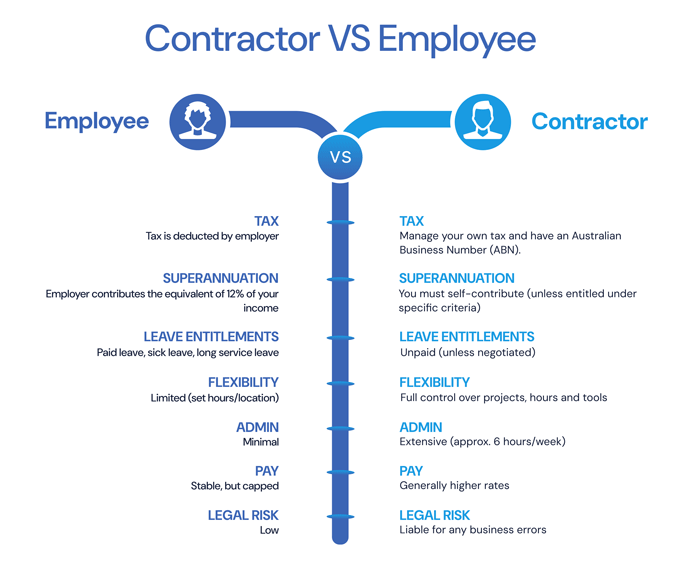

What are the benefits of being an employee
- Regular income
Regular payments, either weekly or monthly, which makes saving and budgeting easier. - Employee benefits
Peace of mind with benefits that Include:- Superannuation
- Paid sick and annual leave
- Long-service leave (Usually after 10 years of employment.)
- Parental leave
- Career growth
Employers often provide:- Personal development budgets
- Internal upskilling initiatives
- Career and promotion pathways
- Minimal Admin
Your employer takes care of tax, superannuation, and any legal obligations, like insurances.

The downsides of being an employee
- Less flexibility
Hours and location are usually dictated by your employer. - Income limits
Salaries are determined by your employer. - Less tax deductions
Less allowable deductions compared to contractors. (However, there are still plenty of work-related deductions you can claim. Using a tax agent can help you claim all that you’re entitled to each year.) - Risk of career stagnation
When employers have set roles with growth ceilings, it can limit your career progress and/or promotion opportunities.
What are the benefits of being a contractor
- Greater flexibility
Be your own boss and set your own hours. Work from anywhere. Choose your clients and projects. - Higher income potential
Contractors generally earn 20%-50% more than employees in similar roles. - Broader experience
Gain experience across multiple industries to broaden your skills, faster. - Tax advantages
Claim deductions on:- Business set up costs
- Equipment purchasing, set up and leasing costs
- Insurances
- Software subscriptions
- Travel and vehicle expenses
- Home office expenses
- Professional development and conferences
- Industry subscriptions
- And other expenses directly related to earning income from contract work.
The downsides of being a contractor
- Lack of job security
Contracts end, sometimes with no notice. It’s not always easy to start a new contract right after an existing one ends. - No entitlements
No paid leave or sick days. Any time off is usually unpaid. - Heavier admin burden
Invoicing, tax, GST and record-keeping can take up time, especially if, like many contractors, you don’t have the energy to stay on top of everything all the time. - ATO’s 80/20 rule
Watch out for the ATO’s Personal Services Income (PSI) rules. If 80% or more of your PSI comes from one client, you may fail the “results test” and be subject to PSI rules, which limit the deductions you can claim. (See below for more details)
Tax Obligations: Contractor vs Employee
What about tax? Well, as you may expect, there are big differences between contractors and employees when it comes to tax and superannuation commitments:

Employee Tax Setup
Employee tax obligations are simple, with minimal time spent on admin.
- Tax: Your tax is deducted by your employer prior to you receiving your salary. They pay it to the ATO on your behalf.
- Reporting: You must lodge an annual tax return.
- Superannuation: Your employer contributes 12%. (In some circumstances, such as for government employees, this percentage is even higher.)
- Tax deductions: Job-related expenses and other deductible expenses, such as charity donations and income protection (if paid for outside of your superannuation).
- Admin: Low effort: Record keeping for deductible expenses and tracking for work from home hours, car expenses, etc.

Contractor Tax Setup
Contractor tax obligations take some time set up and stay on top of.
- Tax: You need pay your own income tax, Medicare levy, and GST (if you earn over $75K).
- Important note: If you run your contractor business as a company, your tax rate may be lower than if you are an employee. Be sure to get specific tax advice as to what contracting set up is most tax advantageous for you.
- Reporting: Quarterly BAS and annual tax returns.
- Superannuation: You need to pay your own superannuation, unless working mainly for one business client, in which case Super Guarantee (SG) may apply.
- Tax deductions: Claim a wide range of business set up, equipment, insurances and other costs relating to working as an independent contractor. Plus, almost all of the typical “employee” tax deductions will also apply.
- Admin: Medium/high effort: You need to keep good records of your income and expenses. Generally, it’s easier to use accounting software and hire an accountant.

Did you know: According to research undertaken by Xero in 2023, Australian contractors spend around 6 hours a week on general admin and pay $370 each month on tax and financial admin.
Contractor vs Employee Case Studies
It’s one thing to list the differences but putting them into context needs a little real-life scenario. So, let’s look at a couple of case studies to help clarify the differences between contractors and employees:
Case Study 1: Emma | IT Project Manager (Sydney)
Employee to Contractor path
Age: 38
Background: Emma worked as a full-time IT Project Manager for a large Sydney-based technology company for 7 years. Her base salary was $130,000 + 12% super, and she received 4 weeks annual leave, 2 weeks paid sick leave, and private health cover through a company plan.
Why did Emma switch to contracting?
After being made redundant due to a company restructure, Emma decided to explore contracting to gain flexibility and increase her income. As a result, she signed up with a tech recruitment agency and began a 12-month contract with a major bank at $850 per day.
So how did that work out?
Emma’s income breakdown as a contractor:
- Daily rate: $850 x 5 days a week.
- Annual earnings: ~$204,000 gross (48 working weeks).
- Superannuation: Not included in contract, so she contributes to her own fund.
- Tax status: Emma registered as a sole trader with an ABN.
- GST registered: Yes (as she earns over $75,000 a year).
- PAYG instalments: Yes. Lodged quarterly.
- Business deductions claimed:
- Laptop and equipment: $2,400
- Home office expenses: $4,200
- Professional development (software updates): $1,800
- Accounting and software fees: $2,000 annually
Why does contracting work for Emma?
- Freedom: Emma values the freedom to choose projects and negotiate rates with her clients.
- Flexibility: Contracting gives her the flexibility to take time off to travel a few times a year.
- Higher income: Despite the lack of paid leave, the higher income offsets unpaid downtime.
- Organisation: Emma works with an Accountant who helps manage her quarterly BAS, PAYG instalments, and super contributions. She also uses accounting software to raise invoices and keep track throughout the year.
Income comparison:
Now that Emma is a contractor, here’s what her basic income (not including deductions) looks like:
| Employee | Contractor | |
| Gross income: | $130,000 + 12% Super | $204,000 |
| Tax | $32,388 | $62,018 |
| Super payment | (*$15,600) | $24,480 |
| Take home | 97,612 | $117,502 |
What Emma has to say about her switch to working as a contractor:
Contracting is much better financially, and I really love the flexibility, which allows me to travel more. I pick my clients and can negotiate my contracts, depending on the complexity of the project, which is great. But it does come with less certainty, and I need to stay super organised with the financial end of it all. The best thing is, sometimes I can work while I’m traveling. It doesn’t get much better than that!
Case Study 2: Jake UX Designer (Melbourne)
Contractor to Employee path
Age: 42
Background: Jake spent 4 years working as a freelance UX Designer across Melbourne’s startup scene. He charged $700 per day and typically worked 4–5 days a week. As a contractor, he paid his own superannuation and looked after his quarterly Business Activity Statements (BAS). He also kept good records or his business expenses, including his travel expenses, software subscriptions and coworking space fees.
Why did Jake switch to becoming an employee?
After years of juggling clients with short term or one-off projects, Jake craved stability, collaboration, and to be an integral part of a product team, long term. As a result, he accepted a full-time role with a mid-sized SaaS company that offered a $125,000 salary + 12% super, 5 weeks annual leave, paid sick leave, and access to an employee wellness program.
So how did that work out?
Jake’s income and benefits as an employee:
- Base salary: $125,000 per year.
- Superannuation: 12% employer contribution (~$13,750 annually).
- Annual leave: 5 weeks paid leave.
- Sick leave: 10 days paid.
- Additional benefits:
- Access to a company wellness program (includes, mental health support, gym discounts). Professional development budget for courses and conferences.
- Team and project bonuses.
- Tax status: Employee (tax withheld by employer).
- Work-related tax deductions claimed:
- Home office expenses: $2,250
- Laptop bag: $150
- Travel expenses: $1050
- Subscriptions: $235
- Graphic mouse pen: $315
- Income protection: $930
- Admin load: Minimal.
- Insurance and superannuation: Covered through employer’s default fund and group policy.
Income comparison:
Now that Jake is a employee, here’s what his basic income (not including deductions) looks like:
| Employee | Contractor | |
| Gross income: | $125,000 | $168,000 |
| Tax | $30,788 | $46,858 |
| Super payment | (*$15,000) | $20,480 |
| Take home | $94,212 | $100,982 |
Why does being an employee work for Jake?
- Stability: Jake now enjoys regular pay and a stronger sense of team belonging.
- Collaboration and learning: He gets to see projects through from start to finish now, and uses his PD budget to build his knowledge and skills.
- Less responsibility: He loves not having to spend hours every week on business admin anymore.
What Jake has to say about his switch to becoming an employee:
Contract work gave me freedom, but full-time work gives me focus and stability, plus the gym membership and bonuses are great! I still use my creative skills, but now I’m a part of every project, end to end. I love getting together with the rest of the team to nut out solutions and ideas. The best bit though, is there is way less admin! I just have to lodge a tax return and keep my receipts!
Contractor compliance and advice
If you decide on the contractor route, make sure you get the right advice, so you’re not tripped up by misconceptions or ATO rules:
Beware of sham contracting
Sham contracting occurs when a business wrongly classifies a worker as a contractor—even though, in practice, they operate like an employee.
In most cases, if a contractor works set hours, uses company equipment, and follows the business’s direction, they’re considered an employee under the law.
Often, sham contracting happens because an employer wants to avoid paying standard employee benefits and entitlements.
Consequently, penalties for sham contracting can be severe, with substantial fines for businesses that break the rules.
Note: It’s also illegal for a business to pressure someone into becoming a contractor. So, if that happens to you, walk away.
Consequently, Fair Work encourages anyone who thinks they’re in a sham arrangement to seek advice from their website:
The 80/20 rule
The 80/20 rule is a guideline from the Australian Taxation Office for personal services income (PSI). In essence, it means that if a contractor earns 80% or more of their PSI from one client, they may be classified as an employee for tax purposes.
“The 80% rule, or 80/20 rule as it is sometimes called, relates to personal services income (PSI) and can change how an independent contractor:
- reports their income in their own tax return
- claims some business-like deductions.
It’s not a factor a business considers when they work out whether a worker is an employee or independent contractor.”
Source: Australian tax office
To clarify: The 80/20 rule is only relevant for tax purposes from the contractor’s perspective. It does not influence how a business defines the working relationship. You remain a contractor, but with restricted tax benefits, similar to an employee.
Think the 80/20 rule might apply to you?
Talk to your tax agent so you know exactly what your need to do.

Going the contractor path? Get the right advice
Whether you’re changing jobs, picking up side work, or diving into full-time contracting, it’s wise to consult a tax agent or financial advisor. That way, you can stay on top of your obligations and avoid any surprises.
They will help you to:
- Set up your work arrangement legally.
- Identify and claim all your eligible tax deductions.
- Ensure you meet ATO compliance and obligations.
- Work out what contractor liability insurance you’ll need.
- Plan an adequate superannuation payment strategy.
- Set up the correct type and level of insurance.
A little expert advice upfront can save you a lot of time, stress, and money down the track.
In Conclusion:
Should I be a contractor or an employee?
Employee:
Best for Security & Structure
Contractor:
Best for Flexibility and Pay
When you’re thinking about changing jobs or the way you want to work, it’s completely normal to feel unsure about which arrangement will suit your lifestyle, circumstances, and long-term goals. That said, you can start narrowing things down. By considering a few key factors, you’ll be in a better position to make a confident choice:
For example, ask yourself:
- Am I seeking the security of steady income and benefits, or the flexibility and income potential of working independently?
- How confident am I in handling my own finances and tax obligations?
- Do I thrive when focused on a single long-term mission, or prefer juggling diverse, shorter-term projects?